


Welcome to our Learning EBM Corner!
Our aim is to provide an introduction to the essential concepts of evidence-based medicine and resources for medical learners to advance their knowledge of EBM. We will continue to update this page with more information and resources so stay tuned!
What is EBM?
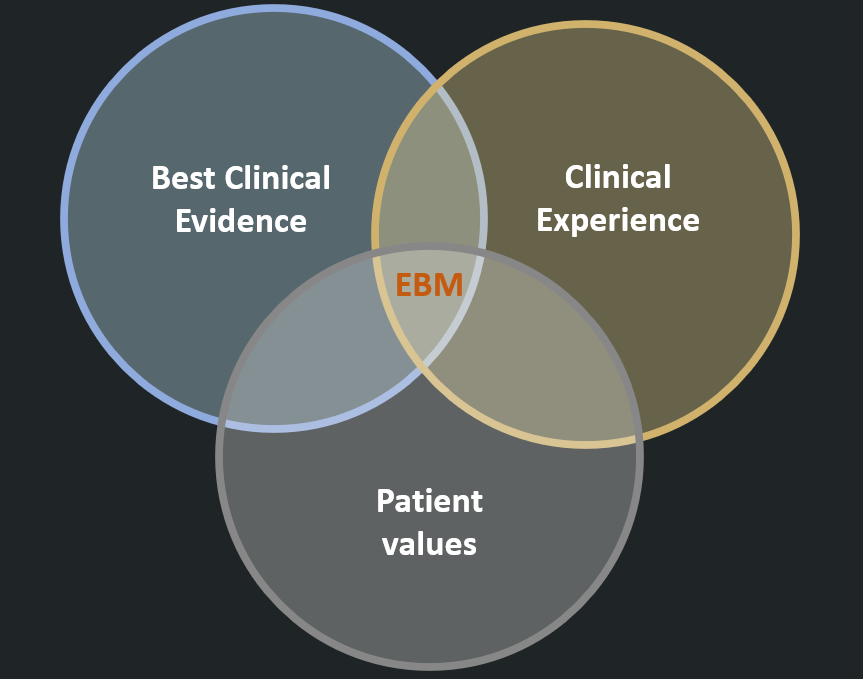
Evidence-based medicine (EBM) is the utilization of the best available medical research to guide the clinical care of patients. EBM works best when it integrates the most reliable science with the expertise and knowledge of physicians and the values of patients. In order to achieve this, it is important that clinicians know what research is driving medical guidelines and have a solid understanding of the fundamentals of appraising that research.

What are the levels of medical evidence?
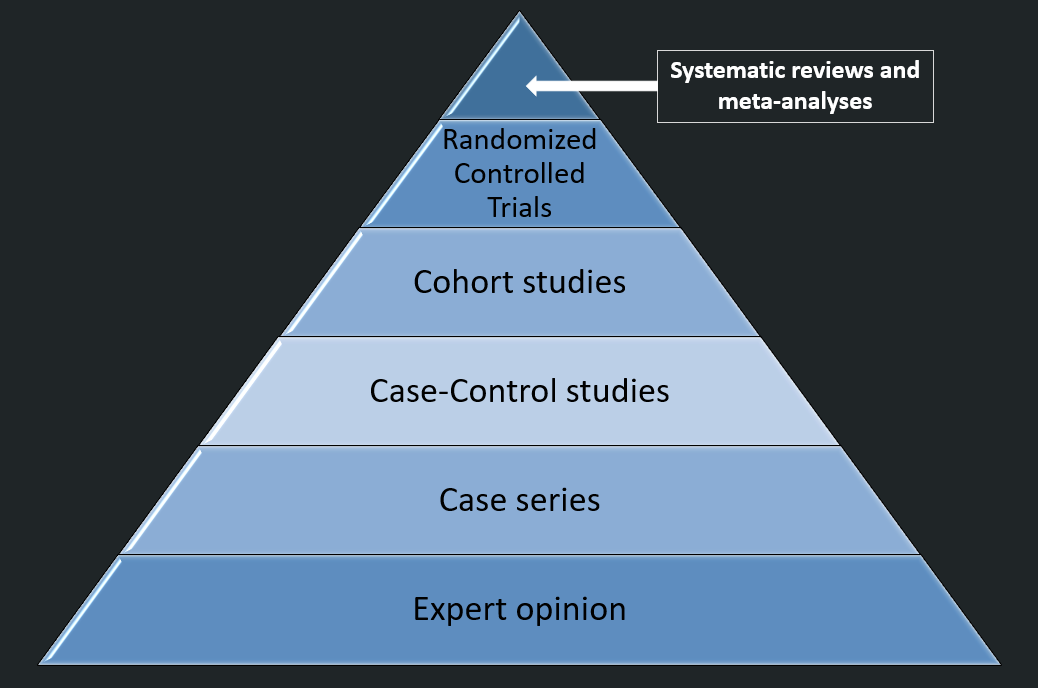
There are various types and formats of medical research. Types of observational research include case series, case-control studies, and cohort studies. The most important experimental research is the clinical trial. Generally, the best form of a clinical trial is one in which the experimental therapy is tested against standard of care (or a placebo), and patients are randomly assigned to each group – the randomized clinical trial (RCT).
Below is a general hierarchy of the usual strengths these types of medical research – keep in mind this is assuming that these research studies are well conducted. Even an RCT can give misleading results if poorly conducted!

How can I formulate an EBM question?
One of the simplest ways to understand how to frame an EBM question is through PICO:
- Population – define the population you are interested in
- Intervention – the intervention you would like to study
- Control – what you compare to the intervention to assess if the intervention is superior (typically standard of care, if none available then placebo)
- Outcome – the clinical result you are interested in
An example – how effective is daily aspirin at reducing cardiovascular events in diabetic patients compared to a placebo? This question has actually been assessed via an RCT – the ASCEND study published in 2018.
How can I assess if a clinical trial was conducted well?
There are several important things to consider when evaluating a clinical trial:
- Does the study compare the intervention to a control (placebo or current standard of care)?
- Was there randomization of subjects?
- Were treatment and control groups similar in characteristics?
- Was the study blinded?
- Single-blinded if only patients are blinded, double-blinded if both patients and investigators are blinded
- Was their sufficient follow up of the subjects?
- Was the analyses of patients intention-to-treat analysis (were subjects analyzed in the group they were initially randomized)?
- How significant are the results (both statistically and clinically)?
- How applicable are the results to your clinical practice?
Below are several checklists and appraisal tools that can be used to evaluate medical research:
- CASP Study Appraisal Checklists: https://casp-uk.net/casp-tools-checklists/
- CEBM Appraisal tools: https://www.cebm.ox.ac.uk/resources/ebm-tools/critical-appraisal-tools
- Al-Jundi A, Sakka S. Critical Appraisal of Clinical Research. J Clin Diagn Res. 2017;11(5):JE01-JE05. https://www.ncbi.nlm.nih.gov/pmc/articles/PMC5483707/
These are some basic introductory concepts that are foundational for EBM. We will continue to grow our Learning EBM corner. In the meantime, you can utilize the resources below to learn more about EBM!
Resources
- Students 4 Best Evidence has a library with a lot of high-yield and useful links to study from: https://s4be.cochrane.org/blog/2020/07/15/library/
- Cochrane Training – learn with free online training provided by some of the best EBM experts: https://training.cochrane.org/
- Cochrane UK Introduction to EBM: https://uk.cochrane.org/our-work/free-information-and-resources-pupils-and-students-interested-evidence-based-health-care
- Epidemiology for the Uninitiated – a short book that can be read online at BMJ: https://www.bmj.com/about-bmj/resources-readers/publications/epidemiology-uninitiated
- Annals of Internal Medicine – Journal Club: https://www.acpjournals.org/topic/category/journal-club